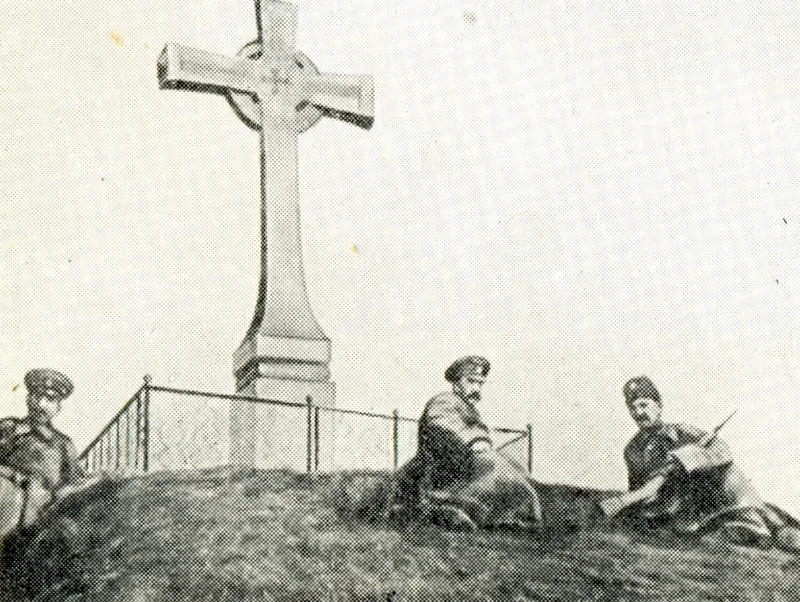

Taras Hill
The poet asked to be buried in Ukraine, and it took a journey across an empire to grant the wish. Taras Shevchenko died in Saint Petersburg in 1861 and was first laid to rest there, in the Smolensky Cemetery, far from the Dnieper he had spent his life writing about. Within weeks his admirers brought his body home to this hill near Kaniv, a green mound above the river once called Chernecha Hora, the Monk's Hill. Since then it has been the beating heart of Ukrainian remembrance, a place where a nation comes to stand with its poet, and where, more than once, others have come to keep it away.
The Monk's Hill
Long before Shevchenko, this ground was holy. The hill belonged to Kaniv's Holy Dormition monastery, an Eastern Orthodox house that had stood here since the eleventh century, and it served as a burial place for several hetmans of Ukraine, among them Ivan Pidkova and Samiylo Kishka. So when the poet was carried up its slope in 1861, he joined a hill already heavy with memory, a place where leaders of the Cossack past lay in the earth above the Dnieper. The choice was fitting. Shevchenko had summoned that very past in his verse, and now he would rest among the men whose world he had helped his readers imagine.
A Grave the Powerful Feared
A poet's tomb does not usually need guarding, but this one did. In 1914, as Ukrainians prepared to mark the hundredth anniversary of Shevchenko's birth, the imperial Russian government dispatched gendarmes and Cossacks to the hill to prevent people from making the pilgrimage. The gesture revealed how much power a grave could hold. Shevchenko's writing carried the Ukrainian language and spirit through an age when both were suppressed, and the crowds who wished to honor him were, in the eyes of the authorities, something to be feared and blocked. Even in death, the poet drew the attention of those who ruled the land he had written for.
Monument on the Bluff
Over the twentieth century the hill took on the form visitors know today. It became part of the Kaniv Nature Reserve in 1923, and in 1926 a dedicated museum-reserve for Shevchenko was established here. In 1939 the sculptor Matvey Manizer cast the great bronze statue of the poet that still crowns the height, set beside a new museum building designed by the Ukrainian architects Vasyl Krychevsky and Petro Kostyrko. Together, statue and museum turned the grave into a monument on the bluff, visible above the trees and the wide gleam of the Dnieper. Chernecha Hora is recognized as a historical, natural, and cultural monument of national importance to Ukraine.
An Act of Fire
The hill has also witnessed sacrifice of the starkest kind. In 1978, a man named Oleksa Hirnyk climbed Taras Hill and burned himself to death in protest against the Soviet suppression of the Ukrainian language, culture, and history. He chose the date with care: the sixtieth anniversary of the 1918 declaration of Ukrainian independence, and the poet's grave as his setting. His death, long kept quiet, became remembered as an act of extraordinary conviction, one man laying down his life on the hill of the poet who had given words to the cause. Today the crowds return in peace, climbing the slope to stand where Shevchenko rests, above the river that carried him home.
From the Air
Taras Hill rises at about 49.73 degrees north, 31.51 degrees east, on the right bank of the Dnieper near Kaniv in Cherkasy Oblast, central Ukraine. From altitude, the broad Dnieper and the wooded bluffs above Kaniv are the key markers, with the poet's monument standing on the crown of the hill. The nearest major airfields are Cherkasy downstream and Bila Tserkva to the west.
Nearby Stories
- Trakhtemyriv 11 km away
- Cherkasy 24 km away
- Motronynskyi Monastery 33 km away
- Khotiv Hillfort 56 km away
- Bila Tserkva 61 km away
- Kholodnyi Yar 63 km away
- Maidanetske 67 km away
- Kachanivka Palace 112 km away