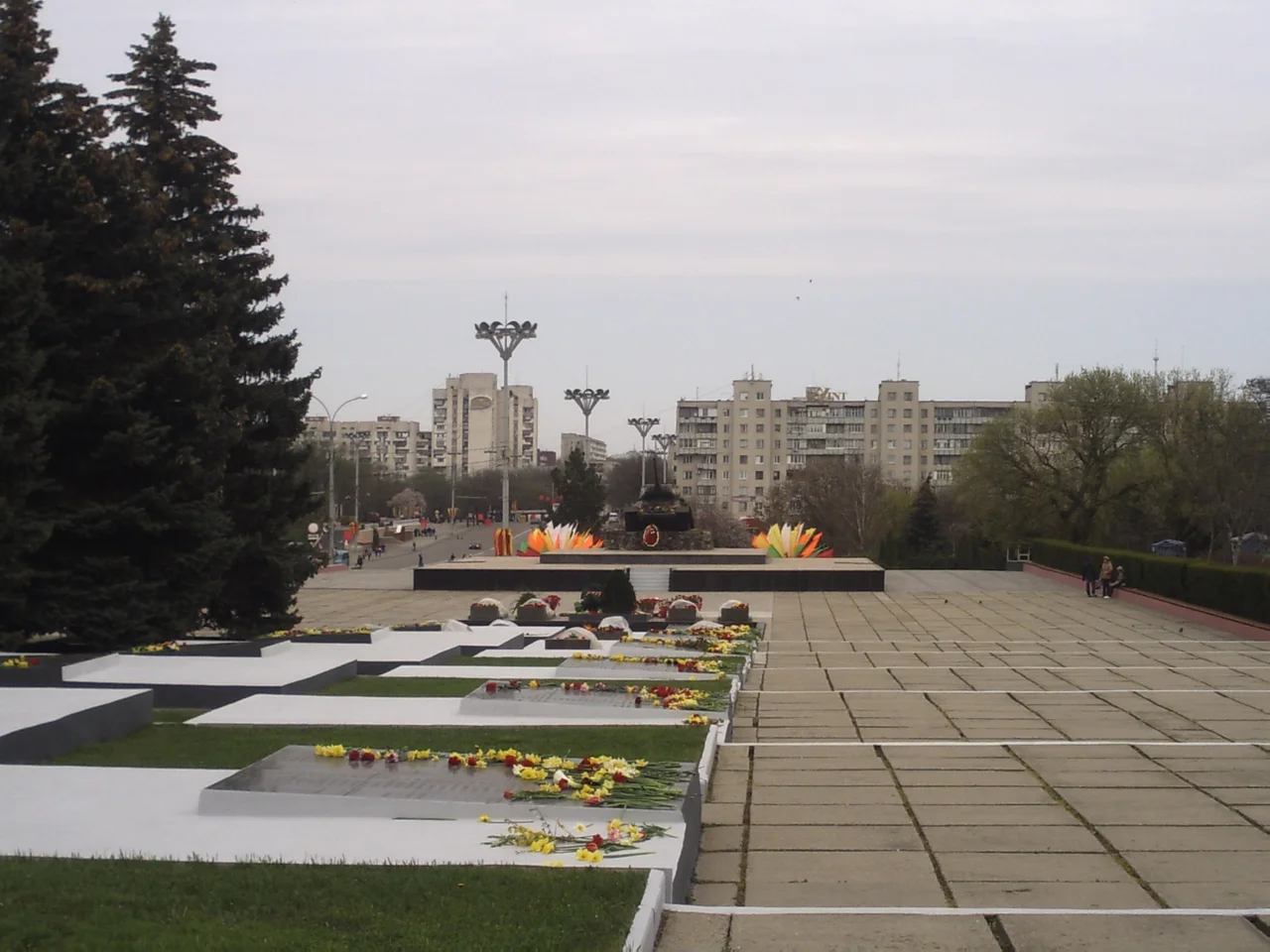

Memorial of Glory
The flame never goes out. It burns at the foot of the Tomb of the Unknown Soldier on Tiraspol's Suvorov Square, and it was lit by a man who had seen the war it commemorates, a Hero of the Soviet Union named Mikhail Kharin. Around that flame gathers one of the most layered war memorials in the region, a place that honors not one conflict but three, spanning half a century of loss. Soldiers of the Second World War, of the Soviet campaign in Afghanistan, and of the brief, bitter Transnistria War of the early 1990s are all remembered here, their names and their machines assembled into a single act of collective mourning.
The Ground Beneath the Monument
This corner of Tiraspol was significant long before the memorial rose. In the 1920s, a square already occupied the site, and during the Russian Civil War the cavalry commander Grigory Kotovsky was buried here after the city was taken from the White forces. The decision to build a formal memorial complex came in the early 1970s, and it opened on Defender of the Fatherland Day in 1972. That same day, in a solemn ceremony, the remains of Red Army soldiers and officers, most of them natives of the region and the Moldavian SSR, were reburied at the new complex. The gesture was intimate as well as official: staff of the Tiraspol museum of local history wrote roughly nine hundred letters to the families and friends of the men laid to rest there, so that each grave might be tied back to a name, a home, a person who was missed.
A Tank With a Father's Grief
Among the memorial's centerpieces stands a T-34-85 tank, and it carries a story that turns a machine of war into something almost unbearably human. The tank had been the combat vehicle of Lieutenant Boris Sergeev, who fought alongside his father, Vasily Antonovich Sergeev, a colonel in the Red Army. Boris and his crew were killed during the Budapest Offensive in January 1945. At his father's request, the tank was brought back from Hungary that April, all the way to Soviet soil. Beneath it now rests a capsule of earth carried from Volgograd, the city whose defense marked one of the war's most terrible turning points. A father brought his son's tank home; a nation buried a handful of sacred soil beneath it. Few war relics anywhere carry their weight so plainly.
Names Carved After the Newest War
The memorial kept receiving the dead. Its last burials came in 1992, during the Transnistria War, and among them was Nikolai Ostapenko, a local council head killed in an attack that April. In 1995 a monument was added for the soldiers lost in the Soviet-Afghan War. When the complex was reconstructed in 2009 and 2010, at a cost of about a million rubles, it gained a Wall of Memory carved with the names of every Transnistrian defender who died between 1990 and 1992, and a sculpture of the Grieving Mother, that eternal figure of war bending over the fallen. In 2011 the small chapel of St. George the Victorious was built and consecrated nearby, adding a place of prayer to a place of remembrance, so that grief and faith might stand side by side.
From the Air
The Memorial of Glory sits on Suvorov Square in central Tiraspol at roughly 46.84 N, 29.61 E, near the Dniester River in Transnistria. It is best appreciated from the ground, but from low altitude the open square, the parade of monuments at the city's south end, and the river are the guiding features. Transnistria has no airport; the nearest is Chisinau International (LUKK) in Moldova, about 70 km west.
Nearby Stories
- Odesa Catacombs 31 km away
- Kuialnyk Estuary 42 km away
- Lower Dniester National Nature Park 43 km away
- Granite-Steppe Lands of Buh 109 km away
- Battle of Vaslui 113 km away
- Bug Gard National Nature Park 139 km away
- Battle of Baia 225 km away
- Lake Sfânta Ana 258 km away